
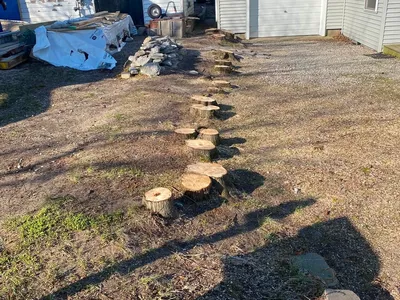
Short answer: for nearly every stump in a yard, grinding is what you want. A grinder chews the stump down several inches below grade, you fill and seed the spot, and you can mow over it within a season. Full stump removal, pulling the whole root ball out with an excavator, is for building sites, driveways, and places where something is going in the ground right there. Published Michigan pricing puts grinding at roughly $3 to $6 per inch of diameter with a minimum charge; removal costs several times more and leaves a crater.
Stumps are the leftover nobody plans for. The tree comes down, the wood gets hauled, and a two-foot-wide stump sits in the lawn for five years catching the mower deck. Here is the difference between the two ways of getting rid of it, what each typically costs, and the one phone call that has to happen before either one.
Grinding: what it is
A stump grinder is a machine with a spinning carbide-toothed wheel that is swung back and forth across the stump, shaving it into chips. A standard grind takes the stump several inches below the surrounding grade, enough to lay sod or seed over it. Ask for a deeper grind if you plan to plant a tree, set a post, or pour a slab where the stump was. Surface roots that run out across the lawn can be chased and ground too, for an extra charge.
The machine is compact. It fits through most gates and between most cottages, and it does far less damage to the lawn than an excavator. What is left is a pile of wood chips mixed with soil, which can be raked back into the hole, spread as mulch, or hauled off. The roots below the grind stay in the ground and rot over the next several years.
Removal: what it is
Full stump removal means digging out the stump and the main root mass, usually with an excavator or a tractor and a lot of chain. It leaves a hole the size of the root ball that has to be backfilled and compacted, and it tears up the ground around it. It costs a lot more than grinding and it takes longer. What it gives you is a clean site: no roots at all where the footing, the septic line, or the driveway base is going. On a lot clearing for a new cabin, the stumps in the building envelope get removed; the ones out in the yard get ground.
Which one you need
| Situation | Grind or remove? |
|---|---|
| Stump in the lawn, want to mow over it | Grind |
| Stump in a flower bed or landscaping | Grind |
| Planting a new tree nearby | Grind deep, or offset the new tree a few feet |
| Building a garage, pole barn, or addition on the spot | Remove |
| Running a driveway or a septic line through the spot | Remove |
| Stump on a steep bank or right at the lake | Usually grind, and check the county's Part 91 soil erosion rules first |
| Dozens of stumps on a cleared lot | Grind, with a lot-rate rather than per-stump pricing |
What grinding typically costs
Stump grinding is priced by the inch almost everywhere. Measure across the widest part of the stump at ground level, including the flare. Published ranges for Michigan run about $3 to $6 per inch, with some sources quoting $2 to $7, and a $100 minimum is common because the machine has to be trailered out for even a small one. So a typical single stump lands somewhere between $100 and $250 in most published figures, and a big old oak stump pushing 40 inches across is more. Additional stumps on the same visit are cheaper each, because the trip is already paid for.
Things that add to it: chasing surface roots, grinding extra deep, hauling the grindings away instead of leaving them, and a stump the machine cannot easily reach. Things that cut it: bundling the grind with the removal of the tree, and having several done at once. If you had us take the tree down, ask for the stump on the same estimate; it is the easiest time to price it.
What removal typically costs
Published figures for full removal vary too much to pin down, because they depend on the machine, the soil, and the size of the root mass, but a fair rule of thumb is several times the cost of grinding the same stump, plus backfill. It is not a bad deal when it is the right tool; it is just the wrong tool for a yard stump.
MISS DIG 811: the call that comes first
A grinder works below grade, and Michigan law requires a MISS DIG 811 ticket at least three business days before any digging. Gas lines, buried electric, cable, and water lines all run through yards up here in places nobody remembers, and a tooth through a gas service is a very bad day. The ticket is free, the utilities come out and paint their lines, and we grind around them. We file MISS DIG on every stump job; ask anyone who grinds for you whether they do.
Near the water there is one more check. Grinding a stump on a lake lot disturbs soil, and within 500 feet of a lake or stream that can bring the county's Part 91 soil erosion permit into play. Our tree removal permits in Michigan article explains when it applies.
Replanting where the stump was
Wood chips and soil settle. After a grind, rake the grindings back into the hole, top with a few inches of topsoil, and expect to add a little more the following spring as the chips break down. For grass, seed right away. For a new tree, plant a few feet to the side of the old stump if you can; the decaying roots tie up nitrogen and the new roots struggle through the old ones. If it has to be the same spot, ask for a deep grind and bring in fresh soil.
Getting a price
Stumps are the easiest thing we quote from a photo. Set a tape measure, a boot, or a five-gallon bucket next to the stump for scale, shoot it from a few feet back, and tell us how many there are and whether the machine can drive to them. Send it through the estimate form or read more on the stump grinding page.