
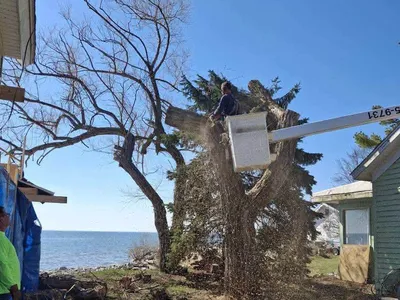
Short answer: a deposit is normal in the tree business and asking for one does not make a company crooked. It does move the risk onto you, though, and after a big storm it is the single most common shape a rip-off takes around here: cash collected in a driveway, a promise to be back Tuesday, and nobody comes. Before you hand anybody money, get proof of insurance, get the price in writing, and slow the conversation down. For what it is worth, we are a no deposit tree service: you pay after the tree removal is finished and you have looked it over. No money up front. You pay when the job is done and you are happy with it.
This comes up on the phone more than almost anything else, usually phrased carefully, as though the person is embarrassed to ask. They are not. It is the right question, and the answer is worth more than a paragraph.
Why deposits are normal in this trade
Tree work eats cash before a single dollar comes in. A day on a mid-size job burns fuel in a bucket truck, a chipper and a dump truck, wears out saw chains and rigging, and covers insurance and wages for whoever is on the ground. On a lot clearing job there can be tipping fees or a hauling subcontractor on top. A company running thin can genuinely need part of the money before the week it works for you, and plenty of honest outfits ask for 25 or 50 percent for exactly that reason.
There is a second reason, and it is more about scheduling than money. A deposit makes it awkward for you to cancel, which protects a crew that has turned down other work to hold your date. That is a real problem for them. It is just not your problem to solve, and it is worth being clear-eyed that this is what the deposit is doing.
What a deposit actually buys you
Nothing, mechanically. Money handed over in advance is not an escrow account and it is not a bond. If the crew never comes back, your recourse is a small claims filing, a complaint to the Better Business Bureau or the Michigan Attorney General's consumer protection division, and a lot of your own time. Those routes work sometimes. They work best when you can produce a written contract, a receipt, and a company that still exists at the address it gave you.
That is the whole argument in one line: a deposit converts your money into a claim. The further along the work is before you pay, the less you are relying on anyone's good intentions.
The pattern that shows up after a storm
Northeast Michigan gets hit. The 2018 straight-line winds through the Tawases, the June 2024 wind event, the March 2025 ice storm that put Alcona and Oscoda Counties under a state emergency: after each one, hundreds of homeowners needed a tree off a roof at the same moment, and consumer protection agencies put out the same warning they put out after every disaster. What people mean when they talk about a tree service deposit scam in Michigan is almost always this exact sequence, and it is consistent enough to recognize:
- They came to you. A truck in the neighborhood, a knock at the door, a crew "already working down the road" who can squeeze you in today.
- Cash, and only cash. Or a payment app to a personal account. Card and check both leave a trail and a way to dispute.
- A big share up front. Half, or all of it, before anything is cut, often framed as being for materials or the dump fee.
- Nothing in writing. No itemized estimate, no company name on anything, sometimes a magnetic sign on a truck door.
- Pressure. The price is only good today, the tree is about to come through the roof, another family is waiting on this slot.
- Out of area. Plates from three states away and a phone number with an area code nobody local uses.
Any one of those on its own can be innocent. A local crew genuinely does drive past your place. Three or four of them together, right after a storm, is the well-worn shape of somebody who intends to be gone by Friday. Slow down. Nobody legitimate loses a job because you took an hour to check them out.
What to ask for before you pay anybody
These five things take about fifteen minutes and rule out nearly all of it.
- A certificate of insurance, sent by the carrier or the agent. General liability, and workers compensation if there is a crew. Ask for it emailed from the agency rather than handed to you as a photo. If a worker is hurt on your property and the company has no coverage, that can land on your homeowners policy.
- A written, itemized estimate. What comes down, whether the stump is included, where the wood and the brush go, and what the total is. A number shouted from a truck window is not a quote. Our tree removal cost in Michigan article covers what those numbers usually look like around here.
- A real business identity. A company name you can look up, a local phone number, and a physical presence in the region. Michigan does not issue a tree-service permit or state card, so there is no license number to check. What you can check is a USDOT number for a company running trucks, a Better Business Bureau listing, and reviews attached to a profile that has been around a while.
- A way to pay that leaves a trail. Card or check, made out to the business name and not to a person. If cash is the only option, ask why.
- Time to think. Unless a tree is actively on your house or into a wire, nothing about this decision has to happen in the next ten minutes.
What a no-deposit tree service looks like
We took the deposit out of the process entirely. Nothing is due to get an estimate, nothing is due to accept the written price, and nothing is due to hold a date on the schedule. We do the work, you walk the yard with us before the truck pulls out of the drive, and the invoice goes out after that, payable by cash or check within 14 days. If a rut needs raking or a limb got missed, that gets fixed before anybody talks about money.
In practice that means you are paying after the tree removal is finished, with no money up front at any stage, and it changes what the conversation feels like. Getting a tree removed without a deposit is not a discount and it is not a gimmick: the price is the price. It just puts the work in front of the payment instead of behind it, which is the order most people assume it already goes in.
We can do it that way because Larry owns the equipment and runs it himself, so a job that slips a week does not put anyone in a hole. We are not claiming it makes us better tree cutters. It just means you are never the one carrying the risk, and you never have to wonder whether we are coming back. The tree removal page walks through how a job actually goes, and the pricing page shows the ranges before you call.
If you already paid and nobody came back
Write down everything you have while it is fresh: the date, what was said, the truck, the plate, any phone number, and the name on the receipt if there was one. Then call your bank or card issuer, because a card charge can sometimes be disputed and a check can occasionally be stopped. File with the Michigan Attorney General's consumer protection division and with the Better Business Bureau; both keep records that help the next person even when they cannot recover your money. Small claims court in your county handles amounts up to a few thousand dollars without a lawyer. And tell your neighbors, because the crews that work this way work a whole road at once.
The short version
A deposit is not proof of anything, good or bad. Insurance, a written price, a checkable identity and no pressure are what actually tell you who you are dealing with. Ask for those from everybody, including us. If you want a price for a tree removal with no money up front and no deposit, send a few photos through the estimate form or call (989) 305-9731 and talk to Larry.