
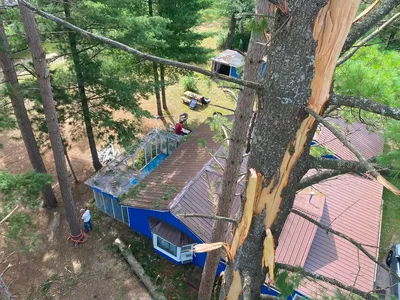
Short answer: most Michigan homeowners policies pay to remove a tree when it damaged a covered structure (the house, the garage, a fence) or is blocking the driveway, usually along with the repair. A tree that simply fell in the yard and hit nothing is often not covered, or only up to a small limit of a few hundred dollars. Every policy is different; read yours or call your agent, and photograph everything before a single branch moves.
We have had three big reminders in the last few years of what the weather can do here. The August 2018 straight-line winds hit Tawas City, East Tawas, and Alabaster Township at around 80 miles an hour and uprooted whole trees by the hundreds. The June 25, 2024 statewide wind event knocked out power to roughly 3,000 Consumers customers in Iosco County, with the worst of it near Oscoda along Lake Huron. And the March 2025 ice storm put Alcona and Oscoda Counties under a state emergency, with outages that lasted weeks and hundreds of thousands of acres of forest damaged. When it is your tree and your roof, here is what to do and what to expect from the insurance side.
What insurance usually covers
- A tree on a covered structure. The house, an attached garage, a detached garage or shed, a fence, a deck. The policy generally pays for the repair and for removing the tree from the structure, subject to your deductible.
- A tree blocking access. Many policies pay to clear a tree that blocks the driveway or a ramp needed by a disabled resident, even if nothing was damaged.
- A tree on a vehicle. That is the auto policy, under comprehensive coverage, not the homeowners policy.
- Your neighbor's tree on your house. Still your policy in most cases. Our article on who pays when a tree falls on the neighbor's property explains why.
What it usually does not
- A tree that fell and hit nothing. Cleaning up a tree that landed in the yard is typically your cost, or covered only up to a small debris-removal limit. Check the policy; some carriers include a few hundred dollars for this.
- A tree that was already dead. Insurers can deny a claim when the tree was an obvious hazard that should have been dealt with. This is the biggest reason to have dead ash tree removal done before the storm rather than after.
- Preventive removal. Taking down a leaning tree before it falls is not a claim. It is a lot cheaper than a claim, though.
The first four things to do after the storm
- Stay clear and check for wires. If any part of the tree is touching a power line, or a line is down anywhere near it, treat everything as live and call Consumers Energy. Nobody, including us, works on a tree tangled in an energized line until the utility has dealt with it.
- Photograph everything before it moves. The tree where it lies, the damage from several angles, the base of the tree where it broke or uprooted, and the wider scene. Take more than you think you need. This is what the adjuster works from, and it is what lets the cleanup start before the adjuster arrives.
- Call your agent, then call us. Open the claim, get the claim number, and ask what the policy needs from the contractor. Then call us with what came down and what it is on.
- Prevent further damage. Policies require it. That means getting the tree off the roof and a tarp over the hole promptly, not waiting a week for an adjuster. Keep every receipt, including the tarp.
What we do on an insurance job
The carrier wants a paper trail, and we build one. The estimate is itemized by task: removing the tree from the structure, taking down what is left standing, cutting and hauling, and any separate work like a second damaged tree in the yard. The invoice matches the estimate line for line, and we include our own photos of the tree before, during, and after. That is the format adjusters are used to seeing, and it keeps the covered work separate from the uncovered work when a claim only pays for part of the job.
Tell us up front that a claim is involved. Some carriers pay you and you pay us; some want to see the estimate before approving the work. Either way, the earlier we know, the fewer surprises. Our storm damage page describes how a cleanup goes.
Why storm-damaged trees are different
A tree lying across a roof is not a log; it is a loaded spring. Uprooted trunks want to roll, bent limbs snap back when the tension is cut, and a trunk resting on a rafter can drop the moment the weight shifts. This is where do-it-yourself chainsaw work goes wrong, and it is why the removal usually starts with a plan for what moves when. From the bucket truck we can take weight off the top before anything on the roof is cut, which is the safe order.
Expect a surcharge, and ask what it is
Emergency and after-hours storm work carries a premium in every published cost guide, most commonly 25 to 50 percent over scheduled rates, and a tree on a house at midnight is the definition of emergency work. That is real: it is a crew working in the dark and the rain. What should not happen is a number that changes after the job. Get the price in writing, even on a storm call. If the tree is in the yard and not on anything, ask whether it can be scheduled at a regular rate in a few days. Often it can.
Before the next one
Every storm season, the trees that cause the most damage were the ones people already knew about: the dead ash by the garage, the leaning pine over the cottage, the oak with the hollow base. A free look at those in September or in the winter costs nothing. Send a photo through the estimate form and we will tell you which ones to worry about. When the storm has already hit, call (989) 305-9731; storm calls get answered around the clock.