
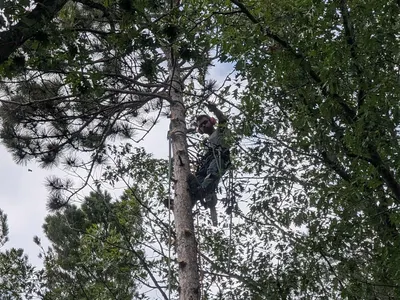
Short answer: prune oaks in the dormant season, roughly November through March, and leave them alone from April 15 through July 15. That window is the Michigan DNR's no-prune period for oak wilt, a fungus that is confirmed in Iosco, Ogemaw, and Arenac Counties and that kills a red oak in a matter of weeks once it gets in. A fresh cut in late spring is an open door for the beetles that carry it.
Oaks are a big part of what makes the lots around Hale, Long Lake, and the Rifle River worth owning, and the red oaks especially are the ones at risk. This is the one piece of tree timing we will not bend on, and here is why.
What oak wilt is
Oak wilt is a fungal disease that plugs the water-carrying tissue of the tree. Red oaks (the group with pointed leaf lobes, including the northern red oak and black oak common on our sandy ground) can go from green to brown and dead within a few weeks of infection. White oaks, with rounded leaf lobes, fight it off longer and sometimes survive for years. There is no cure once a red oak is infected.
It spreads two ways. Above ground, small sap-feeding beetles pick up spores from fungal mats on trees that died the previous year and carry them to fresh wounds on healthy oaks. Below ground, the fungus moves tree to tree through root grafts, which is how a single infected oak turns into an expanding ring of dead ones over a few seasons. Stopping that underground spread usually means cutting the root connections with a vibratory plow, which is specialist work and not cheap.
The no-prune window: April 15 through July 15
The Michigan DNR's guidance is direct: do not prune or otherwise wound oaks from April 15 through July 15. MSU Extension notes the risk peaks in May and June, when the beetles are most active and the fungal mats are fresh. A pruning cut, a limb scraped by a mower, a branch broken off by a storm, or a saw wound from any tree work nearby all count as wounds. The beetles find a fresh cut within minutes in the right conditions.
Some people stretch the caution to the whole growing season, April through October, and that is not a bad instinct. The high-risk stretch is the DNR window, but there is rarely a good reason to cut an oak in August either. Around here we book oak trimming for the cold months and tell customers who call in May to wait, even when we could use the work.
Why winter is the right time anyway
Even without the disease, dormant-season pruning is better for the tree. The leaves are off, so the structure of the crown is easy to read and the cuts are cleaner. The tree is not spending energy on growth, so it seals the wounds efficiently when spring comes. Frozen ground means the bucket truck and the chipper leave the lawn alone. And the schedule is open, which makes it easier to get a date you like. Our trimming page covers what a good winter prune includes.
If a wound happens in the window
Storms do not read DNR bulletins. If a limb breaks off an oak in June, or a truck clips a low branch, do this right away:
- Seal the wound immediately. Latex paint or a tree wound dressing, applied within minutes if you can. This is the one situation where painting a cut is recommended; the goal is to cover the fresh surface before beetles land on it.
- Call for a proper cleanup cut. A torn stub should be cut back cleanly to the branch collar and sealed in the same visit. Do not leave it ragged until fall.
- Keep the saws out of the oaks otherwise. If the storm also damaged maples or pines in the yard, those can be cleaned up normally. The oaks get the minimum cut and the paint.
Firewood and oak wilt
Oak that died of oak wilt can carry the fungus in its bark for about a year. If you have a wilt-killed oak taken down, the wood should be used or covered on site, not moved to the cottage across the lake or sold. Splitting it and letting it dry under a tarp through one summer kills the fungus; after that it burns like any other oak. Our face cord vs full cord firewood prices article covers the don't-move-firewood rules that apply to every species.
Spotting it early
On a red oak, the first sign is usually leaves browning from the edges inward in early to mid summer, starting at the top of the crown, then dropping while still partly green. A healthy oak does not drop green leaves in July. If you see that, especially near Hale or Lupton where the disease is documented, call quickly; there is nothing to save on that tree, but there may be neighbors' oaks to protect. The DNR's Oak Wilt Viewer maps known sites if you want to see how close the nearest confirmed case is.
What we do on oak jobs
Oak trimming, deadwood removal, and clearance cuts get scheduled from late fall into early spring. Oak removals for hazard reasons happen when they need to, with cuts sealed on any neighboring oaks we have to touch. We do not prune oaks between April 15 and July 15, and if you get a quote from anyone who will, it is worth asking them why.
Have an oak that needs deadwood out or a limb off the roof? Get it on the winter list now: send us a photo and we will put a date and a written price on it.