
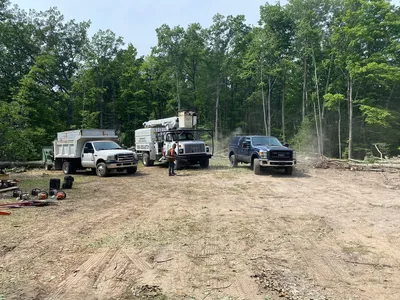
Short answer: published Michigan figures put light clearing, meaning brush and small trees, at roughly $1,200 to $3,600 an acre, and heavy clearing through mature woods at roughly $3,300 to $8,000 an acre or more. Most cabin sites are not an acre. A building envelope, a driveway, and a septic area on a wooded northern Michigan lot is usually a fraction of an acre of real clearing, so the total lands well under the per-acre number. What moves it most is how big the trees are, what happens to the wood, and whether the stumps come out.
The lots we clear around Hale, Lupton, Rose City, and out toward Glennie are mostly jack pine, red pine, aspen, oak, and ash-heavy lowland, on ground that ranges from sand to rock to swamp inside the same forty. Here is how a clearing job gets priced and what to decide before anybody starts.
Light, medium, heavy: what the ranges mean
| Type of cover | Published Michigan range per acre |
|---|---|
| Brush, saplings, scattered small trees | About $1,200 to $3,600 |
| Mixed woods, some mature trees | Between the two, usually in the middle |
| Heavy mature forest | About $3,300 to $8,000 and up |
Those are published ranges from cost guides, not our quote. Northern Michigan sites tend to sit toward the higher end of a given category when the ground is rolling, rocky, wet, or a long way in from the road, and toward the lower end when a machine can work a flat open parcel with a short haul. The only number that matters is the written one you get after somebody walks the property.
What actually drives the price
- Tree size and count. Twenty mature oaks cost more than two hundred saplings.
- Access. If a truck and trailer cannot get in, everything slows down.
- Where the wood goes. Hauling costs money; chipping on site costs less; leaving it costs the least.
- Stumps. Grinding is one price, digging the root balls out for a footing is another.
- Grade work. Clearing is not grading. Leveling a pad or building a driveway base is separate work.
- Season. Frozen ground carries equipment and does far less damage. Winter is a good time to clear.
Do not clear the whole lot
This is the advice we give most often and the one people are gladdest they took. You bought a wooded lot because it is wooded. Clear the building envelope plus a working margin, the driveway, the septic area, and a view corridor if you want one, and leave the rest. Trees left standing shade the cabin in August, block the wind off the lake in January, and hold sandy soil in place. Trees you take out will not be back in your lifetime.
Two more practical reasons. A cleared lot with a lone tree left in the middle of it loses that tree in the first big wind, because it grew up sheltered by the ones around it. And the roots of the trees you keep run out well past the branch tips, so if you want them to live, the machines need to stay off that ground.
What happens to the wood
Your call, and it changes the price. The usual options on a northern Michigan lot:
- Firewood length, stacked or piled for you. The good hardwood gets cut to length and left. Costs you nothing to haul and gives you a couple of winters of heat. See our face cord vs full cord firewood prices article for what that pile is actually worth, and keep the wood on site: Michigan asks that firewood not travel more than about ten miles.
- Chipped. Brush and tops through the chipper, blown into a pile for trails and beds or hauled off.
- Piled to burn. Only where the township and the DNR burn permit rules allow it, and only in the right season.
- Hauled off. Cleanest result, highest cost, because it is trucking.
- Sold as timber. On a big enough parcel with enough merchantable sawlogs, a forester and a logger are a better first call than a tree service. We will tell you when that is the case.
Stumps
Stumps in the building envelope get pulled, because you cannot pour on top of a root ball. Stumps out in what will be lawn or trail get ground, which is cheaper and leaves the ground intact. On a lot with dozens of them, ask for a lot rate rather than a per-stump price. Either way there is a MISS DIG 811 ticket first, at least three business days ahead, because grinding and digging are both below grade work. Our stump grinding vs stump removal article covers the difference.
Permits, and the rule about water
There is no statewide permit for clearing trees on private land in Michigan, but there are three checks worth making before the machines show up:
- Your township. Zoning ordinances can include vegetation preservation language, and some parcels sit in a Natural Rivers overlay along the Au Sable, the Rifle, or the Pine, which carries its own setback and vegetation rules.
- Within 500 feet of a lake or stream. Michigan Part 91 soil erosion and sedimentation control rules generally require a county permit for earth change in that band, and clearing plus stump work on a lake lot is earth change. Work below the ordinary high water mark is an EGLE Part 301 matter. More on tree removal permits in Michigan.
- The driveway approach. A new approach onto a county road needs a road commission permit. In Iosco County that is the Iosco County Road Commission at 989-362-4433.
A sensible order of operations
Stake the corners and the building envelope first, then walk the lot with whoever is clearing it and mark the trees that stay. Flag the drive, the well, and the septic area. Clear, then stump, then grade, then build. Doing it in that order keeps you from paying twice to move the same brush pile, and it keeps a keeper tree from going down because nobody knew it was a keeper.
Getting a number for your lot
Lot clearing is the one job we will not quote from photos alone. Send the parcel number or address, the acreage, a rough sketch of where the cabin and drive are going, and a few pictures from the road, and we will walk it with you. Start with the estimate form or read more on the lot and land clearing page.