
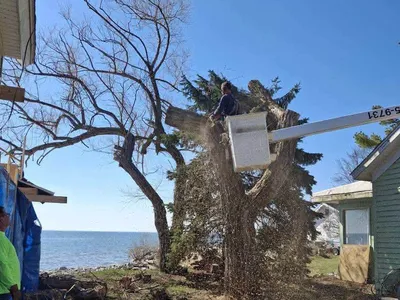
Short answer: it depends on which line. The wire running from the pole to your house, called the service drop, is your responsibility, and a tree near it can be worked on safely once Consumers Energy has done a temporary disconnect; call 800-477-5050 to arrange one. The heavier lines running along the road, the primaries, belong to the utility, and nobody but the utility or its contractors should be cutting anywhere near them. If a tree is in those, you report it to Consumers and wait.
Nearly every older lot around Hale, Tawas, and West Branch has a tree that has grown into the wires somewhere. Sorting out whose problem it is, and how it gets done without anyone getting hurt, is straightforward once you know which line you are looking at.
Know your lines
- Primary lines. The highest wires on the poles along the road, carrying thousands of volts. They are bare, not insulated, and the clearance zone around them is measured in feet. These are the utility's. Consumers Energy trims and removes trees in and around its primaries on its own cycle and its own contractors do that work.
- Secondary lines. Lower wires on the same poles, carrying household voltage between poles and transformers. Still the utility's, still dangerous.
- The service drop. The single bundled cable from the pole to your house or to the meter on a post. This one is the homeowner's responsibility, including the trees near it. It is insulated, but the insulation weathers and cracks, and a tree rubbing on it for a few winters can wear it through. Treat it as live.
- Cable and phone. The lowest wires, often sagging. Not electrically dangerous, but a limb through them takes your internet with it.
Trees in the primary lines: call Consumers, not a tree service
A tree leaning into the primaries, a limb resting on them, or a whole tree down across them after a storm is a utility emergency. Report it to Consumers Energy and keep everyone away. No responsible tree service will put a saw into a tree that is in contact with a primary line, and neither will we. The June 2024 wind event and the March 2025 ice storm both left a lot of trees in the lines around Oscoda, Alcona County, and the lakes, and in every one of those cases the utility crews had to clear the wires before anyone else could touch the tree.
If the tree in the lines is on your property but not touching them yet, and you want it gone, that is a job that can be planned. The utility may trim it back on its schedule, or we can take it down in a way that keeps every piece away from the wires, which sometimes means a temporary shutdown of the line, which only the utility can do.
Trees near the service drop: the temporary disconnect
This is the common case. A maple has grown up around the wire to the house, or a dead ash stands where any limb it drops will land on it. The safe way to work on that tree is with the drop de-energized and, usually, lowered to the ground.
- You call Consumers Energy at 800-477-5050 and ask for a temporary disconnect of your service drop for tree work. They will ask for a date. It helps to have us on the calendar first so the two line up.
- A utility crew comes out, disconnects the drop at the pole (or at the house), and lays it down or coils it out of the way. Your power is off from that point.
- We do the tree work with the wire dead and out of the drop zone. On a straightforward job that is a few hours.
- The utility reconnects and your power is back. Consumers does not typically charge for a tree-work disconnect, though it is worth confirming when you call.
We coordinate this on every job that needs it. Some customers would rather we make the call; either way, the tree is not scheduled until the disconnect is. Refrigerators and freezers ride through a few hours fine; if someone in the house depends on powered medical equipment, say so and we will plan around it.
Why not just be careful?
Because careful is not enough around electricity. A service drop with worn insulation can energize a wet limb, a saw, or a ladder. A limb that swings into a primary line can energize the whole tree. Electrocution is one of the leading ways tree workers die, and Michigan's own safety standard for tree trimming and removal, MIOSHA Part 53, spends a good deal of its length on exactly this. The rules exist because people who thought they would be careful were not careful enough. The disconnect takes a morning and it takes the question off the table.
The do-it-yourself version
If the tree is well clear of every wire, and small enough that nothing it drops could reach one, that is your call. If any part of the tree is within reach of a wire, or if a limb could swing into one when cut, put the saw down. An aluminum ladder against a tree with a wire through it is the accident report everyone has read. This is not a job for a Saturday.
Planting so it never comes up again
The cheapest tree near a power line is the one that was never planted there. Consumers Energy publishes guidance on what to plant under and near its lines: low-growing species directly beneath, medium trees set back, and tall species like the maples, oaks, and pines that grow here kept well away. When we remove a tree from under the drop, we will tell you what could go in its place without repeating the problem in twenty years.
Getting it scheduled
Send a photo that shows the tree and the wire together, plus one of the pole, and tell us whether the wire runs to your house or along the road. That tells us whether it is a utility call, a disconnect job, or a simple removal. Use the estimate form, or read more on the tree removal page. If a tree is on a wire right now, call Consumers Energy first, then us.