
Short answer: sooner than you think. An ash killed by emerald ash borer goes brittle within a year or two of dying, and from then on every season makes it more dangerous to work on and more expensive to remove. A dead ash standing over a house, a driveway, a power line, or a place where people gather should come down this year, not "when we get to it." One out in the back forty can wait; one over the cottage cannot.
Drive any road in Iosco or Ogemaw County and you will see them: gray, bark-shedding ash trees with bare tops, often in the wet lowlands along the creeks. Emerald ash borer got here years ago and it took nearly all of them. What is left is a lot of standing dead wood, and dead ash is a different animal from a dead maple or oak.
What emerald ash borer did
Emerald ash borer is a small green beetle whose larvae tunnel under the bark and cut off the tree's water supply. It has been in Michigan since the early 2000s and is now present statewide; the state repealed its internal quarantine on October 1, 2018 because there was nowhere left to protect. It is no longer even a reportable pest. The one rule still in force is the firewood ban across the Mackinac Bridge northbound, along with the general advice not to move firewood more than about 10 miles.
The tell-tale signs on a dying ash are D-shaped exit holes about an eighth of an inch wide, S-shaped tunnels under peeling bark, woodpecker damage where the birds have been digging for larvae, sprouts shooting from the trunk, and a crown that thins from the top down. By the time the top is bare, the tree is finished.
Why dead ash is dangerous
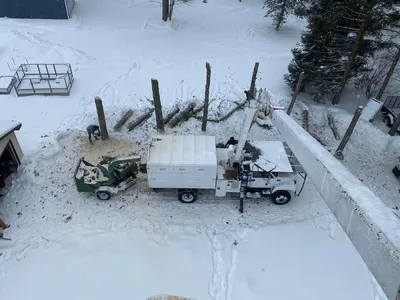
Most dead trees hold together for years. Ash does not. Its wood dries fast and cracks along the grain, the bark sloughs off, and the big limbs go from solid to snapping under a climber's weight with very little warning. Tree workers around the country have been hurt and killed on dead ash, which is why a lot of companies will not climb them at all. We take most of ours down from the bucket truck so nobody is trusting their weight to a dead limb. How bucket truck tree removal works.
The same brittleness is what makes them a hazard to you. A dead ash sheds limbs on calm days, and the whole top can let go in a wind that a live tree would shrug off. The June 2024 wind event that knocked out power across Iosco County dropped plenty of them.
Why waiting costs more
People sometimes hold off on a removal to save money. On a dead ash it works the other way around, for three reasons:
- The job gets slower. A recently dead ash can still be worked with ordinary care. A tree that has been dead three or four years has to be handled like it could come apart at every cut, with smaller pieces and more rigging. More time on site means a bigger number.
- Fewer companies will touch it. As the tree gets worse, the pool of people willing to take it on shrinks, and the ones who will price the risk in.
- It may not wait for you. A dead ash that drops its top on the garage has turned a scheduled removal into an emergency cleanup plus a roof repair, and emergency work runs 25 to 50 percent over scheduled rates in most published figures. Our homeowners insurance and storm tree removal article covers what happens after that.
Which dead ash to prioritize
Not every dead ash is urgent. A rough order of priority we use when a property has several:
- Anything that could reach the house, the garage, a deck, or a parked vehicle.
- Anything over the driveway, a path, a play area, or a spot where people sit.
- Anything near the service drop or within falling distance of a power line.
- Anything along the road frontage that could drop a limb on a passing car.
- Everything else, which can wait for the frozen-ground season or stay as wildlife habitat if it is well away from people.
A dead ash standing in the woods with nothing under it is not a hazard to anyone and is good for woodpeckers. Leave it. Spend the money on the ones that matter.
Can a dying ash be saved?
Sometimes, if you catch it early. An ash that still has more than half of its crown can often be protected with a systemic insecticide injected into the trunk every couple of years by an MDARD-certified applicator. It is an ongoing cost for the life of the tree, and it only makes sense for a tree you really value: the big shade ash over the patio, say. We do not do injections ourselves; we will tell you honestly whether your tree is a candidate and point you toward someone who does. Once the top is bare, treatment is off the table.
What to do with the wood
Ash is excellent firewood. It splits easily, dries quickly, and burns hot and clean. If you heat with wood, have us cut the trunk to firewood length and leave it; that takes hauling off the bill and gives you a winter's worth of fuel. Just burn it at home. Moving it across the region is how the beetle got here in the first place.
Getting it scheduled
A dead ash removal needs the same three things as any other estimate: a photo of the whole tree, a photo of the base, and a sense of what is around it. Access matters more than usual because we want the truck under it. Send the photos through the estimate form or read more on our dead tree removal page. Frozen ground and a bare crown make winter the easiest season for these; if the tree is over something that matters, do not wait for winter.