
Short answer: published ranges for Michigan put most tree removals somewhere between a few hundred dollars for a small tree in the open and several thousand for a big one over a house, with most homeowners landing in the $500 to $1,200 range for a typical yard tree. Size sets the starting point; what is under and around the tree moves the number more than anything else. The only price that matters is a written estimate for your tree, and ours is free.
"How much to take down a tree?" is the question we get most, in driveways from Hale to Tawas and out around Sage Lake. It is a fair question with an honest answer that starts with "it depends," so here is what it depends on, using published Michigan and national ranges rather than our own price list. Every tree gets priced on its own ground.
Typical ranges by tree size
Height is the first thing every published cost guide sorts by, because a taller tree means more cuts, more rigging, and more wood on the ground. Michigan-specific figures run a little below the national numbers, and this is roughly where they sit:
| Tree size | Published range | What that looks like up here |
|---|---|---|
| Small, under 30 feet | Roughly $150 to $500 | An ornamental, a young maple, a scrubby jack pine by the drive |
| Medium, 30 to 60 feet | Roughly $450 to $1,300 | Most yard maples, a mature aspen, a red pine in the side yard |
| Large, 60 to 80 feet | Roughly $800 to $2,800 | A big red oak, a tall white pine over the cottage |
| Very large, 80 feet and up | Roughly $1,000 to $4,700 | Old-growth pine and oak on the older lake lots |
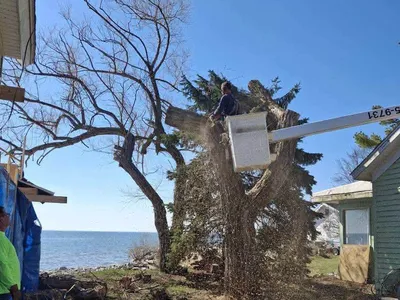
Those spreads are wide on purpose. A 50-foot maple standing alone in a hayfield near Whittemore is a quick drop and a cleanup. The same maple wedged between a cottage and a boathouse on Long Lake is a sectional take-down, piece by piece, with every limb lowered on a rope. Same tree, very different day.
The five things that move the price
- What is under it. A tree that can be felled whole into an open yard is the cheapest kind of removal there is. A tree over a roof, a deck, a septic field, a fence, or a neighbor's shed has to come down in pieces, and published guides put that at 25 to 50 percent over an open-yard removal.
- Access. Our bucket truck does the heavy lifting on tall trees, but it has to get within reach. A tree at the back of a narrow lake lot with no truck access becomes a climb-and-rig job, which is slower and priced accordingly.
- Wires. Anything near the service drop to the house usually means coordinating a temporary disconnect with Consumers Energy before the work starts. Trees in the main lines along the road are the utility's job, not ours. Our trees near power lines in Michigan article explains which is which.
- Condition of the tree. A dead ash or a storm-split oak is more dangerous to work than a healthy tree, because the wood does not hold the way it should. Dead trees often take longer, not less time, and the price reflects that.
- What happens to the wood. Hauling everything away, chipping the brush on site, or cutting the trunk into firewood lengths and leaving it stacked for you are three different amounts of work. If you want the wood, say so; it usually trims the price.
The extras that show up on a quote
A good written estimate lists every line, so you know what you are comparing. The common add-ons around here:
- Stump grinding. Almost never included in the base removal price. Published ranges run a few dollars per inch of stump diameter with a minimum charge. Our stump grinding vs stump removal article covers it.
- Emergency or after-hours work. A tree on the house at 2 a.m. in a storm is a different job from a scheduled removal. Published surcharges run 25 to 50 percent over routine rates, and honestly, sometimes more. If it can wait until daylight, it should.
- Travel. We are based in Hale and work a wide loop through Iosco, Ogemaw, Alcona, and Arenac Counties. Out at the far edge of that loop, a travel line can appear on the estimate.
- An already-downed tree. Cutting up and hauling a tree that is already on the ground is much cheaper than taking one down, as long as it is not resting on something or under tension.
Why winter is often the cheapest season
Northern Michigan hands you one real advantage: frozen ground. A bucket truck and a chip box on frozen turf leave far less mess than on soft April ground, the leaves are off so the crew can see what it is cutting, and the schedule is lighter than it is in June. For a removal that is not urgent, asking for a winter date is the easiest way to keep the number down. It is also the right season for anything oak, for reasons our when to trim oak trees in Michigan article explains.
How to compare two quotes
When two numbers for the same tree sit far apart, the difference is usually in what is included, not in who is being generous. Line them up and ask five things: Is the stump included? Is the wood hauled or left? Is the brush chipped? Is the crew insured, and will they send a certificate of insurance? And is the number in writing? A verbal price shouted from a truck window is not a quote. Ours comes on paper, with the insurance certificate available on request, before anything is cut.
Getting your number
The quickest way to a real price is a few photos: the whole tree from a distance, the base of the trunk, and whatever is near it. Most of the time that is enough for a ballpark the same day. Trees near a house, a wire, or the water get a look in person before the number is final, and that visit is free. Start on our tree removal page, or send the photos now and Larry will call you back.