
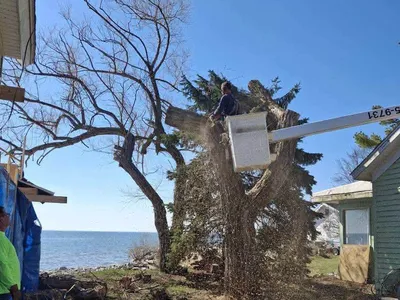
Short answer: Michigan has no statewide permit for taking down a tree on your own land, and on most rural lots in Iosco, Ogemaw, Alcona, and Arenac Counties you do not need one. The exceptions are real, though: a tree in the road right-of-way belongs to the road commission, a city like East Tawas manages its street trees, and work at the water's edge or that disturbs soil near a lake or stream can bring EGLE and county rules into it. Check with your township before you assume.
People moving up from downstate are used to cities where every tree over a certain size needs a form and a fee. Up here it is looser, but "looser" is not "anything goes." Here is how the pieces fit, and how we handle it before a job is scheduled.
Private land: usually no permit
For a tree standing in your yard, on your acreage, or in your woodlot, there is no state permit and, in the rural townships we work in, generally no township permit for removal either. Plainfield Township around Hale has a zoning section on landscaping and preserving existing vegetation, and a few townships have overlay rules on specific rivers, so the honest answer is "probably not, but ask." Your township office can tell you in one phone call, and if you would rather, we make the call for you.
Two things do change that picture on private land. Subdivision or association covenants on some of the lake developments around Sand Lake, Long Lake, and Sage Lake can restrict what comes down, so read the deed restrictions if you have any. And if the tree is dead or hazardous, nearly every rule bends toward getting it down safely; a hazard tree is not the one anybody wants to stop you from removing.
Lake and river lots: the 500-foot rule
This is the one that catches cottage owners. Two state rules apply along the water:
- EGLE Part 301 covers work below the ordinary high-water mark of an inland lake or stream. Cutting a tree that stands up on the bank is not that; dragging a machine through the shallows or pulling a stump out of the bank can be.
- Part 91 soil erosion and sedimentation control requires a permit from the county when soil is disturbed within 500 feet of a lake or stream. Felling a tree and hauling the wood usually does not disturb soil. Grinding stumps, grading the site afterward, and driving heavy equipment over soft ground on a lake lot can, and that is when the county wants a permit and some silt fence.
The Au Sable, the Rifle, and the Pine also carry Natural Rivers designations with their own setback and vegetation rules. If your property backs onto one of them, that is a specific check worth making before a saw starts. Our lot clearing cost in Michigan article gets into this for building sites near the water.
Road right-of-way: not your tree
The strip of ground along a county road is the road commission's, and so are the trees in it, even when they look like yours and you have mowed around them for twenty years. In Iosco County that is the Iosco County Road Commission in Tawas City, and any work in the right-of-way needs their permit; they require proof of general liability insurance to issue one. Ogemaw, Alcona, and Arenac have their own road commissions with the same general setup. State highways like M-65 and M-55 fall under MDOT.
Practically, that means if the tree you want gone is between the road and the ditch, call the road commission first. Sometimes they will remove a hazard tree themselves; sometimes they will permit a contractor to do it. Either way, do not have it dropped without asking.
Inside city limits
Tawas City, East Tawas, and West Branch are cities with a Department of Public Works, and they manage the trees in the public right-of-way along their streets. East Tawas, for example, runs a street tree program through its DPW. A tree in your front yard is still yours; the one between the sidewalk and the curb usually is not. When in doubt, the DPW office answers the question quickly.
Power lines and MISS DIG
Two more checks are not permits but work the same way:
- Consumers Energy. A tree touching or leaning toward the primary lines along the road is the utility's to handle. A tree near the service drop to your house is yours, and the safe way to work on it is a temporary disconnect arranged by calling Consumers at 800-477-5050. More in our guide to trees near power lines in Michigan.
- MISS DIG 811. Michigan law requires a MISS DIG ticket at least three business days before any digging, and stump grinding counts. It is free, and we file it on every grind.
What "no license required" means for you
Michigan does not license tree services. There is no state card a tree company has to carry, which is why you will not see us claim one. What you should ask for instead is proof of insurance. A certificate of insurance from the company's carrier, showing general liability coverage, is the document that protects you if something goes wrong on your property. We send ours with a written quote on request, and any outfit that hesitates to do the same is telling you something.
How we handle it on a real job
When you call about a tree, we ask where it is: yard, road frontage, or waterfront. If it is near the road, we check with the road commission. If it is within a few hundred feet of a lake or river and the job involves stumps or grading, we talk through the Part 91 question with you and the county. For most yard trees from Hale to Rose City, the answer comes back "no permit needed" the same day and we schedule the work. The point is that you never find out about a rule after the tree is down.
Have a tree you are not sure about? Tell us where it stands on our estimate form, or read more on the tree removal page. We will sort out the paperwork question before we quote the job.