
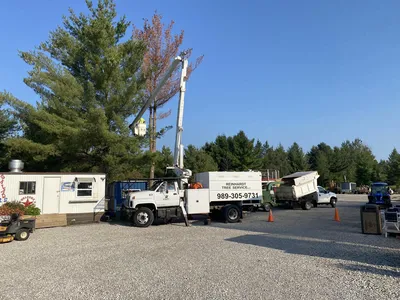
Short answer: a bucket truck is a truck with a hydraulic boom and a platform on the end, so the person running the saw stands on a platform instead of hanging in the tree. It is the fastest and safest way to take down a tall tree, a dead tree, or a tree over a house, as long as the truck can get within reach of it. When it cannot, because of a fence, soft ground, a back lot, or a tree too far off the two-track, the same tree comes down by climbing and rigging instead.
People ask about the bucket truck more than any other piece of equipment, usually because they have a big one near the house and want to know whether the job is going to involve somebody with a chainsaw sixty feet up on a rope. Here is what the truck does, when it is the right tool, and what it needs from your yard.
What the truck actually does
Ours is a forestry bucket truck with a chip box on the back, so the boom, the crew, and the place the brush goes all arrive on the same vehicle. The boom lifts the platform up into the tree and the operator takes the tree apart in pieces, working from the top down. Limbs go straight to the chipper and the trunk comes down in blocks small enough to handle. Nothing has to fall as a whole tree, which is the entire point when a tree is standing over a roof, a septic field, a fence, or a deck.
Because the platform can be moved away from the piece being cut, the operator is never standing on the wood he is cutting. That is a real safety difference on a dead tree, where you cannot trust a limb to hold the weight of a person.
When the bucket is the right call
- Dead ash and other brittle trees. Emerald ash borer left standing dead ash all over this part of the state, and dead ash cracks and drops limbs without warning. We do not climb them if we do not have to. More on dead ash tree removal.
- Trees over structures. Cabin, garage, deck, well head, drain field. Pieces get roped down or dropped into a clear spot instead of the tree going wherever it wants to go.
- Storm damage. Hung-up limbs, half-broken tops, and trees leaning into other trees are the worst things to climb, because the load is already sitting somewhere nobody can see. After the June 2024 wind event and the March 2025 ice storm, most of that work was bucket work.
- Trees near the service drop. Once Consumers Energy has done a temporary disconnect of the wire to your house, arranged at 800-477-5050, the bucket makes short work of the tree above it. More on trees near power lines in Michigan.
- Big trimming jobs. Raising a canopy over a driveway or pulling limbs off a roof line goes faster from a platform than from a ladder or a rope.
When we climb instead
Plenty of trees around here are nowhere near a truck. A tree behind the cottage on a Sage Lake lot, a tree in the middle of a fenced back yard, a tree at the end of a soft two-track in April: those get climbed. Climbing with saddle, rope, and rigging is the older skill and it is still the answer more often than people expect. It is slower, so it can cost more for the same tree, which is one reason we want to see the approach before putting a number on the job.
What the truck needs to get to your tree
| What we look for | Why it matters |
|---|---|
| A path roughly the width of a driveway | The truck is a full-size chassis, not a pickup |
| Firm ground, or a drive to set up on | Outriggers put real weight on small pads |
| Overhead clearance on the way in | Low limbs and the service drop crossing the driveway |
| Room to swing the boom | The platform has to reach the tree, not just get near the trunk |
| Septic tank, drain field, and well location | We stay off them, so tell us where they are |
| The driveway culvert and approach | A soft culvert is a bad surprise for everybody |
Lake lots are the common problem. Cottage driveways around Hale, Long Lake, and Sand Lake tend to be narrow, sandy, and steep on the way down to the water, and the tree in question is usually on the lake side of the cottage where the truck cannot go. If that is your situation, say so up front. It does not mean the job cannot happen; it changes how it happens and what it costs.
Will it wreck the lawn?
On firm ground, usually not much. Outrigger pads spread the load and most of the driving happens on the drive. On soft spring ground we set up on the gravel and reach, lay mats, or ask to wait a couple of weeks. Frozen ground in winter is the best of all, which is part of why we push removals that are not urgent toward the cold months. If there is any doubt, that conversation happens before the truck rolls onto grass, not after.
Safety, and the rules that apply
Aerial lift work in tree care is covered by the Michigan MIOSHA Part 53 standard for tree trimming and removal and by the ANSI Z133 industry standard: fall protection in the platform, hard hat and eye protection, a rescue plan, and hard limits on working anywhere near energized lines. That last one does not bend. Nobody but the utility and its own contractors works near the primary lines along the road, bucket truck or not.
Getting it looked at
Send three photos: the tree, whatever is underneath it, and the drive or path from the road to where the tree stands. That third one answers most of the question. Use the estimate form, or read more on the bucket truck service page. Larry runs the bucket himself, so the person pricing the job is the person who will be standing in it.