
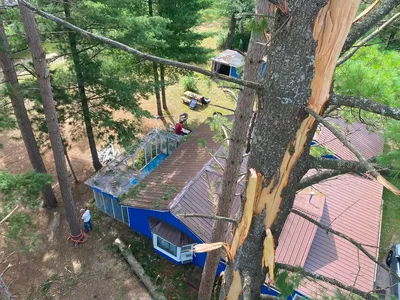
Short answer: in Michigan, when a healthy tree comes down in a storm, each property owner generally deals with whatever landed on their own side of the line, through their own insurance if there is damage. The tree's owner is usually only on the hook when they knew the tree was dead or dangerous and left it standing. That is the general rule, not legal advice; if there is real damage, talk to your insurance agent and, if it is serious, a Michigan attorney.
This one comes up every time the wind blows hard along Tawas Bay or through the lake country around Hale. The neighbor's oak lands on your pole barn, or your pine lands on their boat, and the first question after "is everyone okay" is "who pays for this." Here is how it usually shakes out, and what you can do ahead of time so it never becomes an argument.
The healthy tree in a storm: nobody's fault
Michigan, like most states, treats a sound tree that falls in a windstorm or ice storm as an act of nature. The owner of the tree did nothing wrong, so they are not liable for where it landed. If it hit your garage, your homeowners policy handles your garage. If it landed in your yard and hit nothing, the cleanup on your side is generally your cost, though a lot of neighbors work that out with a handshake and a chainsaw. Our homeowners insurance and tree removal article covers what a policy typically pays for.
People find this unfair at first, and then they think about the reverse case: their own healthy maple going over onto the neighbor's cottage in a straight-line wind like the one that hit Tawas City and East Tawas in August 2018, when trees that had stood for eighty years went down by the hundreds. Nobody could have predicted which ones. That is what insurance is for.
The dead tree everyone knew about: negligence
The rule changes when the tree was a known hazard. If your neighbor's ash has been dead and bark-less for three years, you have mentioned it twice, and it finally drops its top onto your shed, the argument that this was an unforeseeable act of nature gets thin. An owner who knew, or reasonably should have known, that a tree was dangerous and did nothing can be held responsible for the damage. That is a negligence claim, and it turns on what the owner knew and when.
Which is why documentation matters more than anything. The neighbor who wants to be protected writes it down; the neighbor who wants to be covered fixes it.
How to document a hazard tree next door
- Talk first. Most people do not know their tree is a problem, and most will deal with it once they do. A conversation over the fence solves more of these than anything else.
- Put it in writing. If talking does not do it, send a dated letter or email describing the tree, why you believe it is a hazard, and what you are worried it will hit. Keep a copy. Certified mail is not required but it removes any "I never got it."
- Photograph it. Dated photos of the dead crown, the fungus at the base, the lean, or the crack. Our signs a tree needs to come down article lists what to look for.
- Get a professional opinion. A written note from a tree service that has looked at the tree and called it a hazard carries weight. We will do that assessment; we would rather the tree came down before the storm.
Branches and roots over the line
A related question: can you cut the neighbor's branches that hang over your yard? In Michigan the general rule is yes, up to the property line, at your own expense, as long as you do not go onto their land and do not harm the tree. Cutting so much off one side that the tree dies or becomes unstable can put you on the wrong end of a claim, so on anything bigger than a few branches, have it done properly and tell the neighbor first. Oaks add a wrinkle: those cuts need to wait for the dormant season, per our guide to when to trim oak trees in Michigan.
A tree standing right on the line is generally treated as owned by both neighbors, and neither one can remove it without the other's agreement. That is a good one to sort out in a friendly conversation rather than in court.
After it falls: what to do first
- Keep everyone away from it, and if a wire is involved, treat it as live and call Consumers Energy before anything else.
- Photograph the tree, where it came from, where it landed, and all the damage before anything moves.
- Call your own insurance agent, whether or not you think the neighbor is responsible. Let the carriers work out who owes whom.
- Get the tree off the structure to prevent further damage; policies expect that, and an adjuster can work from your photos.
- Save every receipt and the itemized invoice from whoever does the work.
When we do storm cleanup that crosses a property line, we invoice the work clearly by what was done and where, so both owners and both insurers can see it. Our storm damage page covers how that goes.
The cheap way out of all of this
Every one of these disputes is cheaper to avoid than to win. A dead or leaning tree near the property line, on either side, is worth a free look before the next front comes through. If it is yours, taking it down on your schedule costs a fraction of what a storm removal plus a neighbor's roof does. If it is theirs, a professional opinion and a polite letter is the whole toolkit. Send us a photo through the estimate form and we will tell you honestly whether it is a problem.
This article is general information about how these situations usually go, not legal advice. For a specific dispute, talk to a Michigan attorney.