
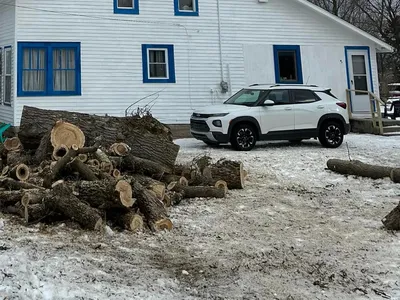
Short answer: a full cord is a stack of wood 4 feet high, 8 feet long, and 4 feet deep, 128 cubic feet. A face cord is the same 4 by 8 face but only one row deep, so with 16-inch pieces it is about a third of a full cord. Around Hale, Oscoda, and the Tawases, seasoned hardwood in local listings mostly runs somewhere between $55 and $105 a face cord, with delivery on top for longer runs. Buy local, buy it dry, and know which cord you are being quoted.
Nothing starts an argument at a gas station in Hale faster than firewood prices, mostly because two people are talking about two different cords. Here is the vocabulary, what the wood is worth, and the rules about moving it that matter more up here than most people realize.
Full cord, face cord, and the words to ignore
- Full cord. The legal unit. 128 cubic feet of stacked wood, usually described as 4 feet by 4 feet by 8 feet, bark and air included. When a state regulation or a serious commercial seller says "cord," this is what they mean.
- Face cord. A stack 4 feet high and 8 feet long, one piece deep. How much wood that is depends entirely on how long the pieces are. At 16 inches, the common stove length, a face cord is one third of a full cord, about 43 cubic feet. At 12 inches it is a quarter cord; at 24 inches it is half.
- Rick, rank, bush cord, truckload. Regional terms with no fixed meaning. "Rick" usually means face cord. "Truckload" means whatever fits in that person's truck, and a full-size pickup bed heaped level holds roughly half a cord. Ask for the stacked dimensions instead.
Face cords per full cord = 48 inches divided by piece length. 16-inch wood: 3 face cords.
What it sells for around here
Northern Michigan firewood is cheap compared to most of the country because the woods are right here. Local marketplace listings from Hale, Oscoda, and Tawas City over the last couple of winters mostly landed in the $40 to $90 range per face cord for mixed or oak hardwood, with established yards charging around $100 or a little more per face cord for dry, split, delivered wood. Nationally, published figures run $75 to $200 per face cord and $150 to $500 per full cord, so anything in the local range is a fair deal. Delivery commonly adds $25 to $75 depending on distance, and stacking adds more.
What moves the price:
- Species. Oak, maple, ash, and beech are the premium hardwoods up here; aspen and pine are cheaper and burn faster.
- Seasoning. Dry wood costs more than green wood and is worth every dollar. Green wood sold in October will not burn well until next year.
- Split and cut to length. Rounds are cheaper than split; odd lengths are cheaper than a consistent 16 inches.
- Delivery and stacking. Picked up at the yard is the cheapest; delivered and stacked on the porch is the most.
Seasoned means what, exactly
Firewood burns well below about 20 percent moisture. Freshly cut hardwood is closer to 50. Getting from one to the other takes a summer of drying split and stacked off the ground with the top covered, and for oak, often two summers. A $20 moisture meter from the hardware store settles the question in seconds: split a piece, press the pins on the fresh face, and read it. Wood that hisses and blackens the glass is green, no matter what the listing said.
Do not move firewood
This is the rule that matters most in our part of the state. Emerald ash borer, oak wilt, beech bark disease, and spongy moth all hitchhike in firewood, and every one of them is present in or near Iosco and Ogemaw Counties. Michigan's guidance is to keep firewood within about 10 miles of where it was cut. State parks and campgrounds ask for certified heat-treated wood, and firewood cannot be carried across the Mackinac Bridge northbound at all. Oak from a tree that died of oak wilt should stay on the property it came from until it has dried through one full summer.
For a buyer, that means the wood from a local tree service or a local woodlot is the safe choice, and the trailer of cheap wood from three counties away is how the next outbreak starts. Our dead ash tree removal and oak wilt trimming window articles explain what is at stake.
Cutting your own in the Huron National Forest
The Huron-Manistee National Forests covers a big piece of Iosco, Alcona, and Oscoda Counties, and it sells personal-use firewood permits for dead and down wood. In 2025 the permits were free for up to 8 cords; for 2026 the forest changed to a $20 permit good for 5 cords, with a limit of three permits. It is real work with a saw, a truck, and a long day, but for people who heat with wood it is the cheapest option going. Check the forest's current rules before you go; areas and seasons change.
Firewood from your own trees
When we take a tree down, one of the choices on the estimate is whether we haul the trunk wood or cut it to firewood length and leave it. For a hardwood tree, leaving the wood takes hauling off the bill and gives you a good part of a winter's heat, split and stacked by you. A single mature oak or maple can yield a full cord or more. It will need a year to dry. Our tree removal page covers the option.
Buying from us
We sell seasoned hardwood from the trees we take down across the area, cut to stove length and split. Delivery is within our regular service area around Hale and Lupton. Price and availability change with the season and the supply, so check the firewood page or send a note with how much you need and where it is going, and we will tell you what we have.